Indian Railways connects millions daily, but long journeys require active security measures. Learn how to prevent railway luggage theft, secure your berth, and use official tools like Rail Madad.
Securing Your Journey on Indian Railways
Traveling by train is one of the most culturally rich and practical ways to traverse India. Spanning thousands of kilometres and connecting remote towns with bustling metros, Indian Railways is the lifeline of the nation. However, the open and public nature of railway networks makes them prime targets for opportunists, petty thieves, and organized criminals. Ensuring personal safety and protecting your belongings requires active situational awareness, physical security measures, and a clear understanding of the safety protocols established by the authorities. By taking a few calculated steps, you can significantly reduce the risk of railway luggage theft and ensure a peaceful, comfortable journey for yourself and your family.
Securing Your Belongings: Preventing Railway Luggage Theft
Luggage security is the most common concern for train passengers in India. Most thefts on trains occur during the night or when passengers are distracted at stations. Implementing a multi-layered security approach is the best defense against theft.
The Chain-and-Lock Method
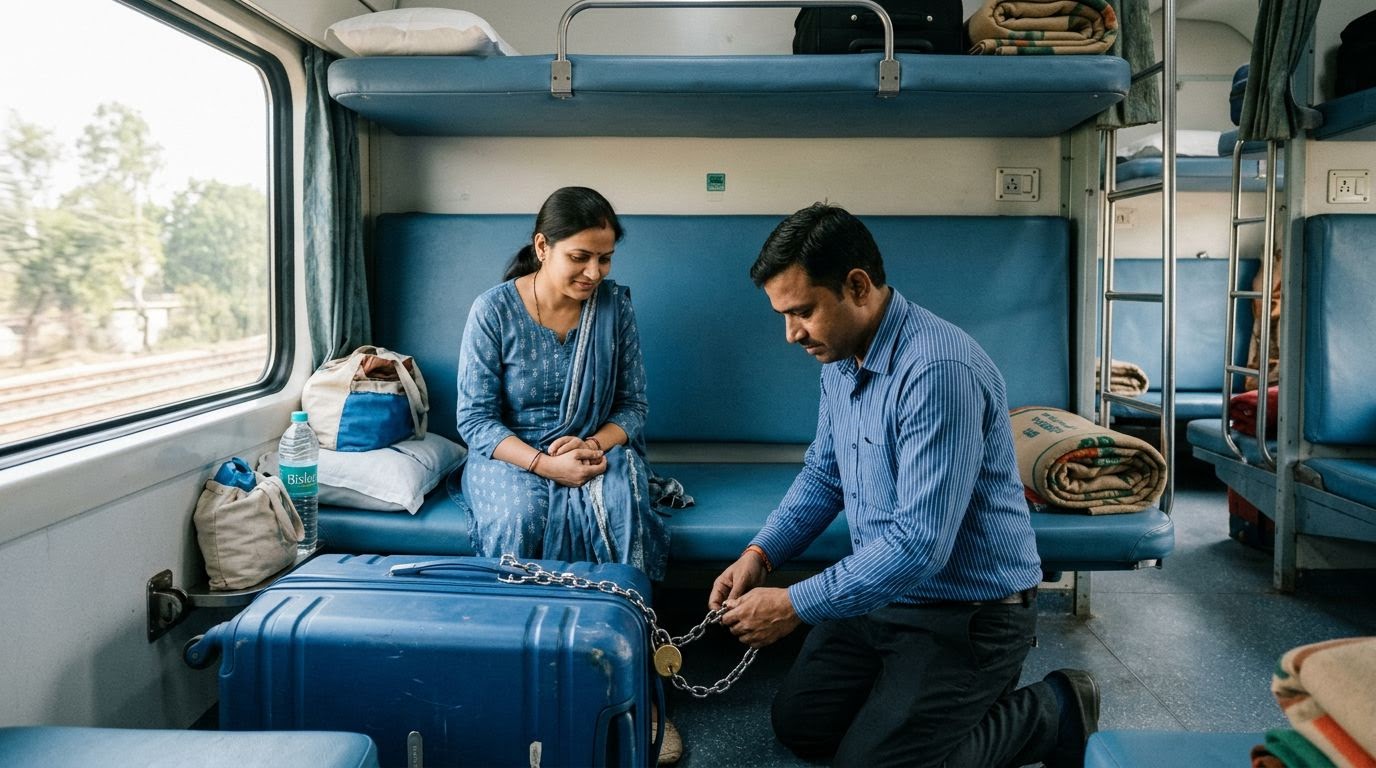
While modern luggage comes with built-in combination locks, they do not prevent an entire bag from being carried away. The traditional practice of chaining your luggage to the metal rings provided under the lower berths remains the single most effective deterrent against opportunistic theft. Always carry a heavy-duty steel chain or a high-quality wire cable lock. Thread the chain through the main handles of all your bags and secure it tightly to the lower berth frame. This prevents quick, quiet snatch-and-run thefts, especially during late-night stops when passengers are asleep.
Keep Valuables on Your Person
Never place high-value items such as cash, gold, laptops, mobile phones, or critical travel documents in your main chained luggage. Keep these items in a small, lightweight backpack or a waist pouch that stays with you at all times. When sleeping, place this smaller bag under your head as a pillow or keep it securely between your body and the compartment wall. Never leave your phone charging unattended on the coach panels, especially when the train is halting at a station, as thieves frequently snatch devices through open windows or from the doorways just as the train begins to move.
Choosing the Right Berth and Coach for Safety
Your choice of travel class and berth selection plays a subtle yet significant role in your overall train travel safety. While emergencies can occur in any class, certain structural elements provide better security.
AC vs. Non-AC Coaches
Air-conditioned coaches (1AC, 2AC, and 3AC) generally offer a higher level of security than non-AC sleeper classes. AC coaches have closed, tinted windows, automatic doors, and restricted entry, which significantly reduces the movement of unauthorized vendors and non-ticketed passengers. Additionally, AC coaches are accompanied by coach attendants who monitor the entry and exit points. If you are traveling alone, with young children, or carrying sensitive equipment, choosing an AC coach is a worthwhile investment in your safety.
Strategic Berth Selection
When booking tickets, try to opt for middle or upper berths if you are traveling alone and wish to minimize contact with passersby. The lower berth is highly accessible to everyone in the compartment and people walking down the aisle. However, for senior citizens or those with mobility issues, the lower berth is necessary. If you have a lower berth, ensure your luggage is securely locked underneath and remain alert to individuals sitting on your berth during daytime hours. If you notice unauthorized passengers occupying seats in your compartment, do not hesitate to ask them to leave or report them to the Ticket Examiner (TTE).
Food and Drink Safety: Avoiding Drugging and Scams
One of the oldest and most dangerous methods used by criminals on trains is food drugging. Unsuspecting passengers are offered tea, biscuits, or water laced with sedatives, leaving them unconscious while the criminals walk away with all their belongings.
The Rule of Refusal
As a strict rule of train travel safety, never accept any food, water, tea, or sweets from co-passengers, no matter how friendly, respectable, or helpful they appear. Criminals often strike up warm, engaging conversations over several hours to build trust before offering a drugged snack. Politely decline any offers by stating you have a strict diet, are fasting, or have just eaten.
Buying from Authorized Sources
Only purchase food and beverages from official IRCTC (Indian Railway Catering and Tourism Corporation) stalls on the platforms, or order directly through the official IRCTC e-catering app. Ensure that bottled water is sealed when you buy it, and crush the bottle after use to prevent it from being refilled and resold by unauthorized vendors.
Navigating Railway Stations Safely
The transition between the station entrance and the train compartment is a high-risk window for both personal safety and luggage security. Crowded platforms, staircases, and foot overbridges are hotspots for pickpockets and bag-snatchers.
Handling Crowds and Boarding
Keep your hands free of unnecessary items when boarding. Wear your backpack on your front rather than your back to keep zippers within your line of sight. If you are traveling with family, establish a clear order of movement: one adult should lead, children should walk in the middle, and another adult should bring up the rear, keeping a close eye on all bags. Avoid boarding moving trains under any circumstances; wait for the train to come to a complete stop.
Station Security Infrastructure
Major Indian railway stations are increasingly upgrading their security infrastructure to protect passengers. While major stations now employ high-tech baggage scanners and walk-through scanners and detectors at entry points, passengers must still remain vigilant. Keep an eye out for integrated security booths and CCTV cameras. If you ever feel followed or threatened on a platform, move immediately toward a brightly lit area, a security kiosk, or a group of railway police officers.
Leveraging Rail Madad and the Railway Protection Force (RPF)
The Indian government has streamlined its grievance and safety mechanisms to provide rapid assistance to passengers in distress. Understanding how to access these services can make a critical difference during an emergency.
How to Use Rail Madad
The Rail Madad portal and mobile application are highly efficient tools for real-time assistance. Whether you are facing a security threat, medical emergency, cleanliness issue, or harassment, you can register a complaint directly through the app or by calling the integrated helpline number 139. Complaints registered on Rail Madad are geo-tracked to your train and coach, and the nearest railway authority or RPF post is alerted to board the train at the next scheduled or unscheduled stop to resolve the issue.
Contacting the RPF on Board
The Railway Protection Force (RPF) and Government Railway Police (GRP) regularly patrol trains, particularly during night runs. If you experience an emergency, look for the train guard, the TTE, or the RPF escort team on board. Under the Bharatiya Nyaya Sanhita, 2023, and railway regulations, these officers are duty-bound to assist you and register your complaint on the spot, eliminating the need for you to alight from the train to file an FIR.
Travel Safety Checklist for Indian Railways
Before embarking on your next rail journey, review this safety checklist to ensure you have taken all necessary precautions:
- Pack light: Carry only as many bags as you can easily manage by yourself without relying heavily on external help.
- Invest in security hardware: Carry at least one strong padlock and steel chain for every large piece of luggage.
- Pre-program emergency numbers: Save 139 (Rail Madad/RPF) and the national emergency number 112 in your speed dial list.
- Keep power banks charged: Ensure your mobile devices and power banks are fully charged before boarding, reducing the need to use public charging points.
- Share your live location: Use secure messaging apps to share your live location and train status with a trusted family member or friend throughout the journey.
- Verify co-passenger details: Check that the people sitting around you match the chart details if anything seems suspicious, and report discrepancies to the TTE.
Key Takeaways
- Always chain and lock your heavy luggage to the berth frame, and keep personal electronics, cash, and documents on your person or under your head while sleeping.
- Never accept food, water, or tea from co-passengers, regardless of how polite or friendly they seem.
- Download the Rail Madad app and remember the integrated helpline number 139 for immediate security, medical, or administrative assistance.
- Opt for AC coaches whenever possible to minimize unauthorized entry and access to your compartment.
- Report any suspicious activity, unauthorized passengers, or security threats immediately to the TTE or the RPF patrol team.
How STSS Can Help
While securing yourself on transit is a personal responsibility, protecting large-scale transit hubs, platforms, and commercial premises requires professional intervention. S. Tiger Security Service (STSS) provides comprehensive physical security services, advanced entrance-control systems, and state-of-the-art screening technology to secure critical infrastructure across India. To learn how we can secure your facility or to discuss customized security deployments, please visit our page and request a security quotation today.
Frequently Asked Questions
What should I do immediately if my luggage is stolen on a train?
Immediately inform the Train Ticket Examiner (TTE) and the on-board RPF/GRP escort team. You can register an instant complaint using the Rail Madad app or by calling 139. The RPF can help you file a 'Passenger Complaint Form' on board, which acts as an FIR, so you do not have to deboard the train.
Is the lower berth safe for solo female travelers?
While the lower berth is comfortable, it is highly accessible to co-passengers and corridor traffic. Solo female travelers often prefer side-upper or upper berths for greater privacy and minimal disturbance. If assigned a lower berth, you can request the TTE to swap it if an upper berth is vacant, or use Rail Madad to report any discomfort.
Can I lock my luggage to the train berth using any chain?
Yes, you can use any standard steel chain and padlock, but it is recommended to use a thick, vinyl-coated steel cable lock. These are lighter, harder to cut with standard hand tools, and do not make noise or scratch the train's interiors.
What is the difference between RPF and GRP on Indian Railways?
The Railway Protection Force (RPF) is a federal force under the Ministry of Railways responsible for protecting railway property, passenger areas, and passenger safety. The Government Railway Police (GRP) is a state-level police force responsible for law and order, investigating crimes, and registering FIRs at stations. Both work in coordination, and calling 139 connects you to the appropriate assistance.
STSS provides trained guards, e-surveillance, access control and turnkey security across India.
This article was drafted with the help of an AI writing assistant and published by the STSS knowledge desk for general awareness only. It is not legal or professional advice. In an emergency, dial 112. Report cyber fraud on 1930 or cybercrime.gov.in.