
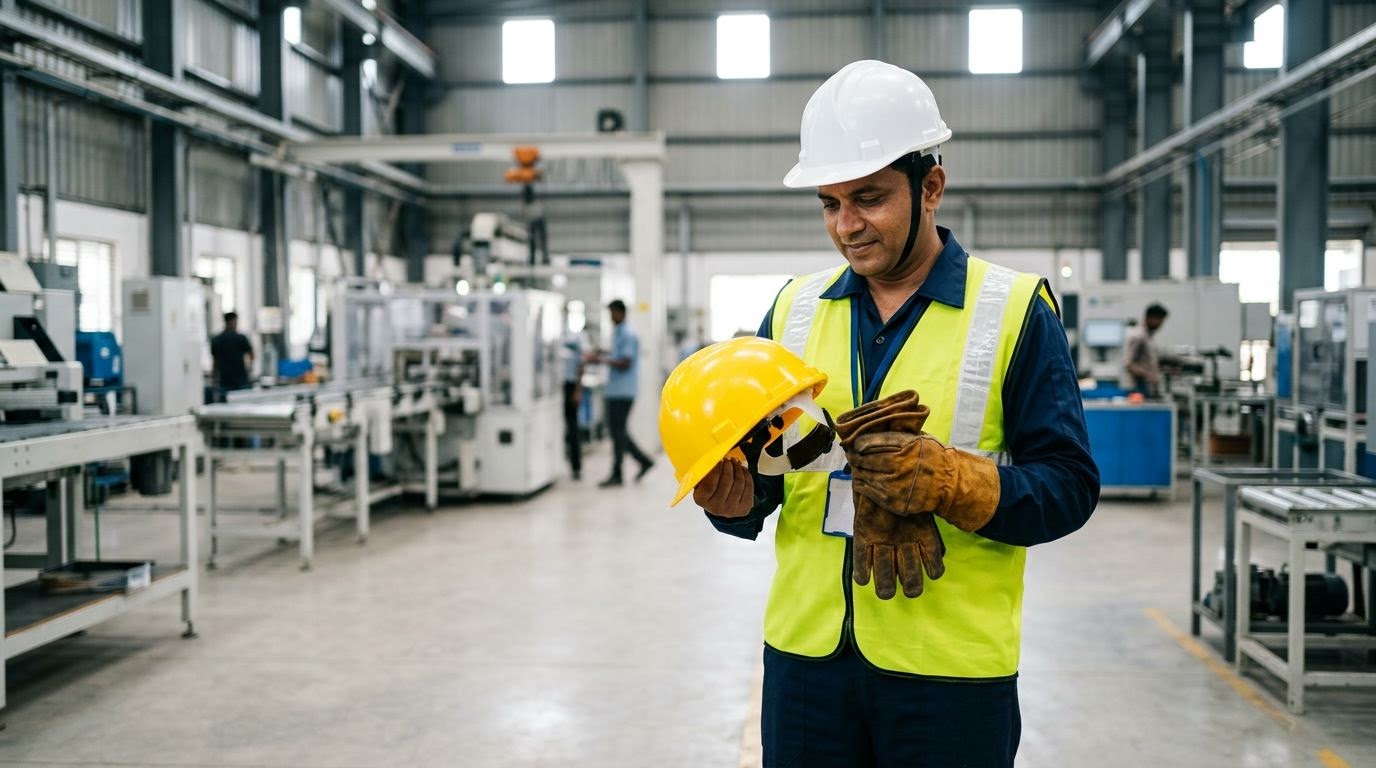
Selecting the correct personal protective equipment (PPE) is critical for industrial safety. This comprehensive guide explains how to choose and maintain helmets, gloves, eyewear, and footwear for Indian workplaces.
In India's rapidly growing industrial sectors, spanning manufacturing, heavy engineering, construction, and warehousing, ensuring worker safety is both a legal mandate and an operational necessity. While engineering and administrative controls are the primary shields against workplace hazards, Personal Protective Equipment (PPE) serves as the critical final line of defense. Selecting the right personal protective equipment is not a matter of buying generic gear; it requires a precise match between the specific hazard and the protective gear, certified by Indian Standards (IS). Ill-fitting or incorrect equipment can create a false sense of security while leaving workers vulnerable to severe injuries.
The Hierarchy of Hazard Control in Industrial Safety
Before deploying personal protective equipment, safety officers and facility managers must understand its position in the hierarchy of hazard control. Developed as a systematic approach to workplace safety, the hierarchy ranks hazard control methods from the most effective to the least effective: Elimination, Substitution, Engineering Controls, Administrative Controls, and finally, PPE. While PPE is the last line of defense, it remains indispensable in environments where hazards cannot be completely engineered out. Relying solely on PPE without addressing the root hazards is an unsafe practice, but failing to provide high-quality, certified gear is equally dangerous.
Head Protection: Selecting the Right Safety Helmet
Understanding Indian Standards (IS 2925)
In Indian industrial environments, the safety helmet is the most recognizable symbol of occupational safety. However, not all helmets are created equal. Under the Bureau of Indian Standards (BIS) specification IS 2925, industrial safety helmets must undergo rigorous testing for impact resistance, penetration resistance, and electrical insulation. A standard safety helmet consists of two main parts: the shell and the suspension system. The shell deflects the force of a falling object, while the suspension system absorbs and dissipates the impact energy, preventing severe trauma to the skull and cervical spine.
Material and Classification Choices
Safety helmets are manufactured from various materials, each suited to specific working conditions. High-Density Polyethylene (HDPE) is lightweight and cost-effective, making it ideal for general construction sites. Acrylonitrile Butadiene Styrene (ABS) offers superior impact resistance and durability in high-temperature environments, such as steel plants and foundries. Fiberglass helmets are preferred in chemical industries due to their high resistance to corrosive substances and heat. Additionally, helmets are classified based on electrical hazards. Class A helmets provide general impact protection and limited voltage protection, Class B helmets are designed for high-voltage electrical work, and Class C helmets offer only impact protection with no electrical shielding.
Hand Protection: Matching Gloves to Specific Hazards
Mechanical and Cut Resistance
Hand injuries account for a significant percentage of industrial accidents in India. Choosing the correct glove requires identifying the specific tasks a worker performs. For material handling, general construction, and heavy fabrication, leather or heavy-duty cotton gloves certified under IS 6994 are essential. These gloves protect against abrasions, minor cuts, and splinters. For high-risk manufacturing environments involving sharp metal sheets or glass, high-performance polyethylene (HPPE) or Kevlar-infused cut-resistant gloves are required, categorized by their cut protection level to ensure adequate defense.
Chemical and Electrical Insulation
When workers handle hazardous chemicals, solvents, or acids, mechanical gloves are useless. Instead, chemical-resistant gloves made of Nitrile, Neoprene, or PVC must be deployed, selected based on the specific chemical's breakthrough time. In electrical maintenance work, non-conductive rubber gloves certified under IS 4770 are mandatory. These gloves must be regularly tested for dielectric strength and air-leaks, as even a pinhole-sized tear can lead to a fatal electrical shock.
Foot Protection: Safety Shoes and Industrial Boots
The Role of IS 15298 Compliance
Industrial safety footwear must comply with IS 15298 to ensure comprehensive protection for workers in factories, warehouses, and construction sites. The standard safety shoe features a protective toe cap, traditionally made of steel, though composite materials like carbon fiber are increasingly popular for their lightweight and non-conductive properties. This toe cap must withstand a minimum impact energy of 200 Joules, protecting the foot from falling heavy machinery, pallets, or metal parts.
Sole Materials and Specialized Protection
The sole of the safety shoe is just as important as the toe cap. Double-density polyurethane (PU) soles offer excellent slip resistance, oil resistance, and shock absorption, which are critical in manufacturing plants. For environments with sharp objects on the ground, such as demolition sites or metal workshops, safety shoes must feature puncture-resistant steel or Kevlar midsoles. Furthermore, electrical maintenance staff require specialized anti-static or fully insulating footwear to prevent grounding during high-voltage operations.
Eye and Face Protection: Shields, Glasses, and Goggles
Preventing Ocular Injuries
Eye injuries in industrial setups are highly preventable yet incredibly common. Flying debris, dust particles, chemical splashes, and intense light radiation pose constant threats. Safety spectacles with side shields, certified under IS 5983, are suitable for general woodworking, machining, and grinding operations. These glasses must be made of impact-resistant polycarbonate, which does not shatter upon impact. For chemical handling, wide-vision safety goggles that form a tight seal around the eyes are necessary to block liquid splashes and harmful vapors.
Welding and Face Shields
For tasks involving extreme heat, molten metal, or intense ultraviolet (UV) and infrared (IR) radiation, such as welding, safety glasses are insufficient. Workers must use full-face shields or specialized welding helmets equipped with auto-darkening filters. These devices protect not only the eyes but also the entire facial skin from severe thermal burns and flash blindness.
Hearing and Respiratory Protection: Managing Invisible Hazards
Combating Noise-Induced Hearing Loss
Unlike physical trauma, noise-induced hearing loss occurs gradually and is irreversible. In environments where noise levels consistently exceed 85 decibels (dB), such as textile mills, generator rooms, and heavy fabrication shops, hearing protection is mandatory. Earmuffs provide high attenuation and are easy to monitor for compliance, while disposable or reusable polyurethane foam earplugs offer a lightweight, cost-effective alternative when properly inserted into the ear canal.
Respiratory Safeguards Against Dust and Fumes
Inhalation of toxic dust, silica, chemical fumes, and organic vapors can lead to chronic respiratory illnesses, including silicosis and occupational asthma. Simple surgical masks offer zero protection in industrial environments. Instead, particulate respirators conforming to IS 9473, such as FFP2 or FFP3 ratings, must be used for dust-heavy environments like cement factories and mines. For chemical plants and paint booths, half-mask or full-face elastomeric respirators fitted with specific chemical cartridges are required to filter out organic vapors and acid gases.
A Comprehensive Checklist for PPE Implementation
To ensure that personal protective equipment is effectively utilized and maintained across your facility, safety officers should adhere to the following operational checklist:
- Conduct Regular Hazard Assessments: Identify and document the specific physical, chemical, biological, and radiological hazards present in each zone of the facility.
- Verify BIS Certifications: Ensure all procured gear, including safety helmets, gloves, and footwear, carries the ISI mark and complies with relevant Indian Standards.
- Enforce Proper Fitment: Ill-fitting PPE is often bypassed by workers. Provide multiple sizes of safety helmets, harness systems, and footwear to accommodate diverse body types.
- Implement a Strict Maintenance Protocol: Establish a routine for cleaning, inspecting, and replacing damaged or expired PPE. Safety helmets, for instance, should generally be replaced every three to five years, or immediately after sustaining a major impact.
- Conduct Training and Awareness Programs: Educate workers on how to properly don, doff, adjust, and care for their protective equipment.
- Monitor Compliance: Use supervisory oversight and safety audits to ensure consistent compliance across all shifts.
Key Takeaways
- PPE is the crucial final line of defense in industrial safety, to be used alongside engineering and administrative hazard controls.
- Always select safety helmets certified under IS 2925, choosing the material based on thermal and electrical risks.
- Hand and foot protection must be task-specific, utilizing certified cut-resistant gloves, chemical-resistant barriers, and steel or composite-toe safety shoes.
- Ocular and respiratory protection require specialized gear like polycarbonate safety glasses, chemical goggles, and certified particulate or gas respirators rather than generic alternatives.
- Regular inspection, proper fitment, and worker training are essential to prevent PPE failure and ensure workplace compliance.
How STSS Can Help
Ensuring complete safety at large industrial sites requires a holistic approach that combines physical security, access control, and operational safety management. At S. Tiger Security Service, we provide comprehensive Security Services and Integrated Facility Management solutions that help factories, warehouses, and corporate offices maintain strict safety protocols, monitor PPE compliance at entry points, and secure their premises against operational risks. Contact our expert team today to Request a security quotation tailored to your facility's unique safety and security requirements.
Frequently Asked Questions
How often should an industrial safety helmet be replaced?
Safety helmets should generally be replaced every 3 to 5 years from the date of issue, or immediately if they sustain a heavy impact, show visible cracks, deep scratches, or signs of discoloration from chemical or UV exposure.
What is the difference between steel toe and composite toe safety shoes?
Steel toe shoes offer excellent impact protection at a lower cost but are heavier and conduct heat and electricity. Composite toe shoes, made of carbon fiber, fiberglass, or plastic, are lightweight, do not conduct electricity or heat, and are ideal for metal-free security environments.
Can standard surgical masks be used as PPE in industrial environments?
No, surgical masks only protect against fluid splashes and do not filter out fine dust, toxic fumes, or chemical vapors. Industrial environments require certified particulate respirators or chemical cartridge respirators.
How do I know if my PPE is certified for use in India?
Look for the ISI mark and the corresponding Indian Standard (IS) number printed on the product or its packaging, such as IS 2925 for safety helmets and IS 15298 for safety footwear.
Is the employer legally required to provide PPE to workers in India?
Yes, under various labor laws and industrial safety regulations in India, employers are legally obligated to provide appropriate, certified personal protective equipment to workers free of charge and ensure its proper usage.
STSS provides trained guards, e-surveillance, access control and turnkey security across India.
This article was drafted with the help of an AI writing assistant and published by the STSS knowledge desk for general awareness only. It is not legal or professional advice. In an emergency, dial 112. Report cyber fraud on 1930 or cybercrime.gov.in.