
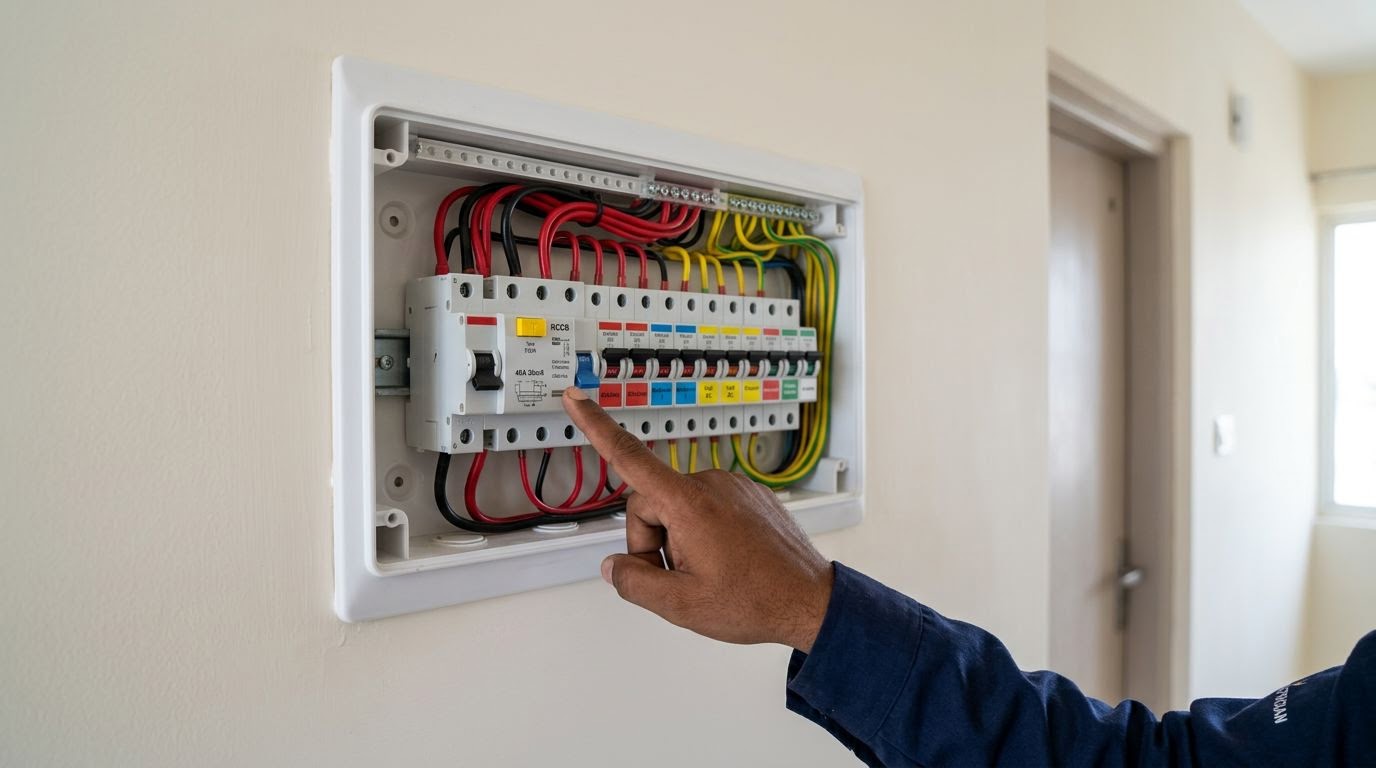
Demystify your home's distribution board. Learn the distinct roles of MCBs, RCCBs, and ELCBs in preventing electrical fires and providing vital electric shock protection.
Understanding the Silent Guardians in Your Distribution Board
Every modern Indian household is familiar with the grey or white metal box mounted near the main entrance or utility area. This box, known as the distribution board, is the central distribution hub for all electrical energy entering your home. While most residents only interact with it to flip a switch back up when the power cuts out, the devices housed inside are critical safety instruments designed to prevent catastrophes. Among these, the terms MCB, RCCB, and ELCB are frequently used by electricians, yet they are rarely understood by homeowners. Knowing how these devices function is the first step toward securing your household against electrical fires and ensuring robust electric shock protection for your family.
The Heart of Your Electrical Network: The Distribution Board
The distribution board is responsible for dividing the main electrical supply into separate circuits, such as lighting, power sockets, and heavy-load lines for air conditioners and geysers. Each circuit must be protected individually so that a fault in one appliance does not shut down the entire house or cause widespread damage. In older Indian buildings, simple rewireable porcelain fuses were used to protect these circuits. Today, modern safety standards dictate the use of specialized automatic switches. A properly configured distribution board acts as a multi-layered defense system, isolating faults in milliseconds to preserve both appliances and human life.
What is an MCB (Miniature Circuit Breaker)?
The Miniature Circuit Breaker, or MCB, is the most common component found inside a modern distribution board. It has entirely replaced traditional fuse wires due to its speed, reliability, and ease of resetting. An MCB is designed to protect electrical wiring and connected appliances from two specific types of faults: overloads and short circuits.
Overload Protection
An overload occurs when too many appliances are plugged into a single circuit simultaneously, drawing more current than the copper wires are rated to handle safely. For example, running a microwave, an electric iron, and an electric kettle on a single 16-Ampere socket line will cause the wires to heat up. The MCB contains a bimetallic strip that bends as it heats up. If the current exceeds the safe limit for a sustained period, the strip bends far enough to trip the mechanism, cutting off the power supply before the wire insulation melts and causes a fire.
Short Circuit Protection
A short circuit is a more severe fault that occurs when a live wire directly contacts a neutral or earth wire, often due to damaged insulation or a internal failure inside an appliance. This creates a path of extremely low resistance, causing an instantaneous, massive surge in current. To handle this, the MCB features an electromagnetic coil. The sudden surge creates a powerful magnetic field that instantly pulls a plunger, tripping the breaker in a fraction of a second to prevent explosive damage and fire.
Important Note: While MCBs are exceptional at protecting property and wiring, they do not offer electric shock protection for humans. A fatal electric shock can occur at a current as low as 30 milliamperes. An MCB rated for 16 or 32 Amperes will not detect this tiny leakage and will not trip, meaning it cannot save a person from electrocution.
What is an RCCB (Residual Current Circuit Breaker)?
The Residual Current Circuit Breaker, or RCCB, is the single most critical device for personal human safety in any residential or commercial building. While the MCB protects your property, the mcb rccb combination ensures that both your appliances and your family members remain safe.
How the RCCB Detects Danger
The operating principle of an RCCB is based on simple mathematics. Under normal, safe operating conditions, the amount of current flowing into a circuit through the phase (live) wire must exactly equal the current returning through the neutral wire. The RCCB constantly monitors and compares these two currents using an internal toroidal transformer.
Instantly Halting Electric Shocks
If a person accidentally touches a live wire or a faulty appliance with a damaged internal connection, some of the electrical current will flow through the human body into the ground. This is known as a leakage current or residual current. Because some current has escaped to the earth, the current returning through the neutral wire decreases. The RCCB instantly detects this minute imbalance. If the difference exceeds its rated sensitivity (typically 30 milliamperes for residential homes), the RCCB trips within 30 milliseconds, cutting off the power before the electric shock can cause cardiac arrest or severe injury.
What is an ELCB (Earth Leakage Circuit Breaker)?
The Earth Leakage Circuit Breaker, or ELCB, is an older category of safety device that was widely installed in Indian homes a few decades ago. While the term is still used colloquially by many local electricians, it is important to understand the technological shift from ELCBs to modern RCCBs.
Voltage-Operated ELCBs
Traditional ELCBs are voltage-operated devices. They work by detecting an excess voltage on the metal framework of an appliance. To function, they require a dedicated physical earth connection running from the appliance's body, through the ELCB, and deep into the physical earth pit. If this earth wire becomes disconnected, corroded, or loose—which is incredibly common in older Indian buildings—the voltage-operated ELCB becomes completely useless and will fail to trip during an emergency.
The Transition to Current-Operated Devices
Because of this critical vulnerability, modern electrical regulations have phased out voltage-operated ELCBs in favor of current-operated devices, which are now standardly classified as RCCBs. Unlike the old ELCB, an RCCB does not rely on a perfect earth connection to detect a leak; it simply measures the difference between incoming and outgoing current, making it infinitely more reliable for residential electric shock protection.
MCB vs. RCCB: A Quick Reference Comparison
To ensure your home is properly protected, it is essential to understand that these devices are not substitutes for one another. They must work together inside your distribution board.
| Parameter | MCB (Miniature Circuit Breaker) | RCCB (Residual Current Circuit Breaker) |
|---|---|---|
| Primary Function | Protects wiring and appliances from overcurrent. | Protects humans from electric shocks and electrocution. |
| Trigger Cause | Overloads and short circuits (high current surges). | Earth leakage and current imbalances (tiny leakages). |
| Sensitivity | High thresholds (typically 6A, 10A, 16A, 32A, etc.). | Extremely sensitive thresholds (typically 30mA for homes). |
| Earth Connection | Does not require an earth wire to operate. | Operates independently of the earthing quality. |
How to Inspect and Test Your Distribution Board
Safety devices are only useful if they are in perfect working order. Mechanical components inside breakers can seize up over time due to dust, humidity, or lack of movement. Homeowners should perform a simple safety check at least once a month.
The Monthly Test Button Routine
Every genuine, certified RCCB is equipped with a small button on its front face, usually marked with a "T" or the word "Test". This button is connected to an internal resistor that deliberately creates a tiny, safe current imbalance when pressed. To test your device:
- Locate your main distribution board.
- Locate the RCCB (it is wider than standard MCBs and has the test button).
- Press the "Test" button firmly.
- The switch should instantly trip downward, and power to the connected rooms should cut off.
- Flip the switch back up to restore power.
If you press the test button and the switch does not trip, your RCCB is faulty or has been wired incorrectly. In this scenario, you must contact a qualified electrical contractor immediately to have it replaced. Do not delay this repair, as a non-functioning RCCB leaves your household entirely unprotected against lethal shocks.
Comprehensive Electrical Safety Checklist for Indian Homes
- Ensure your distribution board has a dedicated 30mA RCCB protecting all general lighting and power circuits.
- Verify that high-power appliances like geysers, washing machines, and water pumps are properly connected to the RCCB-protected lines.
- Perform the manual "Test Button" check on your RCCB on the first day of every month.
- Never bypass a tripping MCB or RCCB with copper wire or tape; a tripping breaker is an active warning of an underlying hazard.
- Have a certified professional inspect your home's physical earthing system annually, preferably before the monsoon season when wet ground increases shock risks.
- Avoid using cheap, unbranded multi-plug adaptors that can overload wall sockets and cause localized heating.
Key Takeaways
- MCBs protect property: They trip during short circuits and overloads to prevent electrical fires, but they do not protect humans from shocks.
- RCCBs protect lives: They detect minute current leakages (as low as 30mA) and cut power in milliseconds to prevent fatal electrocution.
- ELCB is legacy technology: Older voltage-based ELCBs have been replaced by modern, highly reliable current-based RCCBs.
- Regular testing is vital: Always press the "T" button on your RCCB monthly to ensure the internal tripping mechanism is functional.
How STSS Can Help
Ensuring electrical safety in large residential complexes, commercial offices, and industrial plants requires professional expertise. Our experienced Integrated Facility Management teams provide comprehensive electrical audits, thermographic scanning of distribution boards, and preventive maintenance services to keep your infrastructure safe. Protect your premises from electrical hazards and operational downtime by contacting us to Request a security quotation today.
Frequently Asked Questions
Can I replace my RCCB with an MCB to save money?
No. An MCB and an RCCB serve completely different safety functions. An MCB protects your wires and appliances from overheating and fires, while an RCCB protects human lives from lethal electric shocks. Both must be installed together in your distribution board for complete safety.
Why does my RCCB trip frequently during the monsoon season?
During the monsoons, high humidity and water ingress into outdoor light fixtures, water pumps, or external wiring can cause minor current leakages to the ground. The RCCB detects these leaks and trips to prevent shocks. A certified electrician should inspect your outdoor wiring to seal any moisture entry points.
Is a 100mA RCCB safe for home installation?
No, a 100mA RCCB is not safe for human shock protection. It is designed to prevent electrical fires in commercial or industrial setups. For residential homes, human safety standard guidelines require a highly sensitive 30mA RCCB, which trips at a threshold low enough to prevent cardiac arrest.
Does an RCCB require a proper earth connection to work?
No. Unlike the older voltage-operated ELCBs, a modern RCCB does not require an earth connection to detect a leak. It works by measuring the difference in current between the live and neutral wires. However, having a functional earthing system in your home is still highly recommended for overall appliance safety.
STSS provides trained guards, e-surveillance, access control and turnkey security across India.
This article was drafted with the help of an AI writing assistant and published by the STSS knowledge desk for general awareness only. It is not legal or professional advice. In an emergency, dial 112. Report cyber fraud on 1930 or cybercrime.gov.in.