
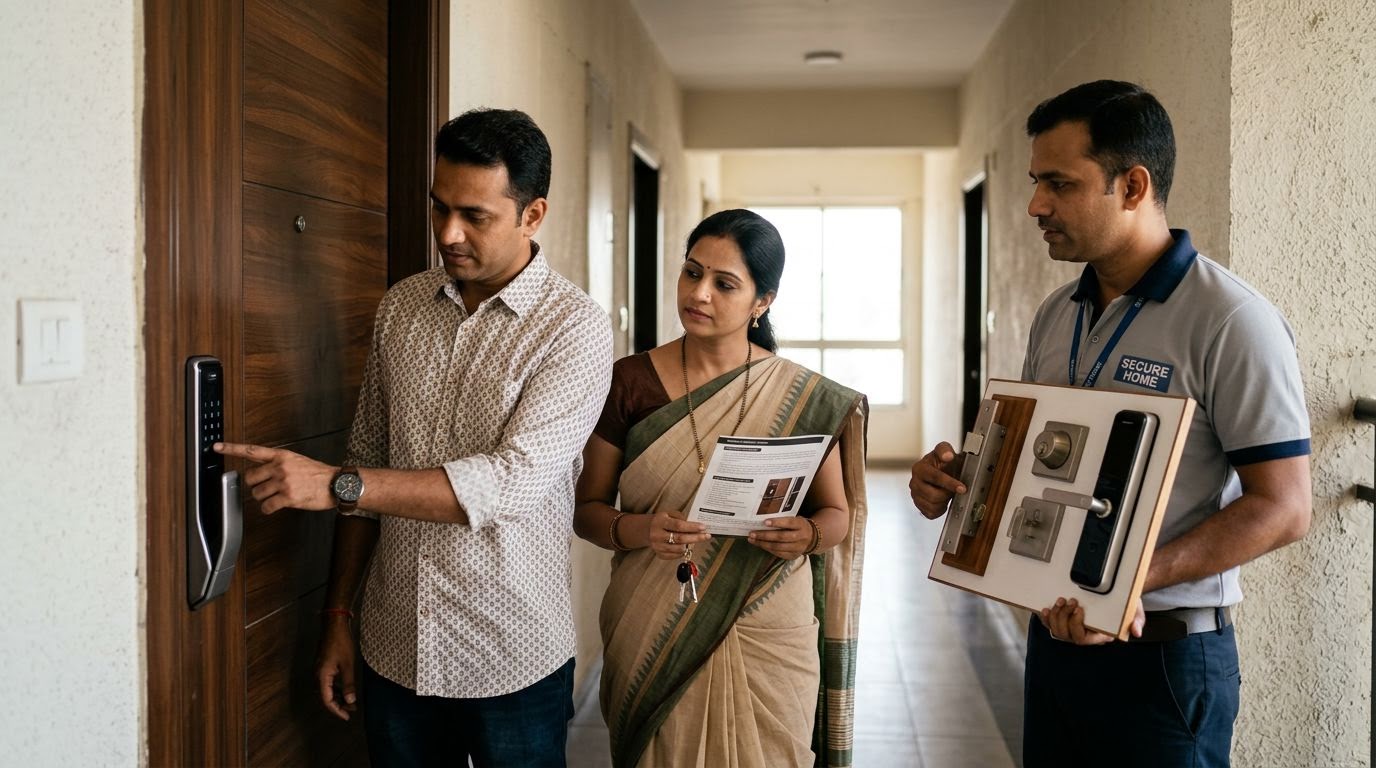
Choosing the right door lock for your Indian home requires balancing security, door material, and convenience. Learn how mortise, deadbolt, multi-point, and smart locks compare.
For generations, securing an Indian home meant pulling a heavy iron latch and snapping shut a solid brass padlock. However, modern residential architecture in India—ranging from high-rise apartments in Pune to sprawling independent bungalows in Mumbai—demands a far more sophisticated approach to home security. Choosing the right door lock is no longer just about buying the heaviest piece of metal available; it is about matching the lock mechanism to your door material, lifestyle, and risk profile. Whether you are a tenant in a rented flat, a family with young children, or an owner of an independent villa, understanding the differences between mortise, deadbolt, multi-point, and smart locks is critical to securing your premises effectively.
The Indian Door Context: Why One Size Does Not Fit All
Unlike Western homes where single-entry doors are standard, Indian homes frequently employ a two-door system: an outer metal safety grill door followed by a heavy main wooden door. Furthermore, the construction material of Indian doors varies wildly, from solid teak wood and engineered flush doors to modern UPVC and aluminium frames. Before purchasing any door lock, you must evaluate the door thickness (typically 30mm to 50mm in India) and the frame structural integrity. A heavy-duty lock installed on a hollow-core flush door provides nothing more than an illusion of safety, as the door itself can be easily kicked in or splintered. Conversely, installing a lock that is too heavy or deep for a thin door can compromise the structural strength of the wood.
Mortise Locks: The Traditional Indian Standard
The mortise lock remains the backbone of Indian residential security. This lock requires a pocket (the mortise) to be precisely cut into the edge of the door where the lock body is housed. It comprises two main components: the lock body and the cylinder which houses the keyway. In India, mortise locks are highly favoured for their aesthetic appeal and clean integration. They combine a latch bolt (operated by a handle) and a deadbolt (operated by a key).
The Evolution to Euro-Profile Cylinders
Older Indian mortise locks relied on fixed lever mechanisms, where losing a key meant replacing the entire heavy lock assembly. Modern mortise locks utilise Euro-profile cylinders. This design allows you to replace only the key cylinder (the part where the key goes in) if you lose your keys or change tenants, leaving the main lock body and handles intact. This is highly cost-effective and convenient for Indian homeowners.
Pros and Cons of Mortise Locks
Mortise locks are extremely durable and offer clean aesthetics since the mechanism is hidden inside the door. They are available in a wide range of premium brass, bronze, and stainless steel finishes to match Indian home decor. However, installation requires professional carpentry, which permanently alters the door. If the wood swells during the monsoon—a common issue in coastal cities like Mumbai—the lock mechanism can become misaligned, making it difficult to operate the key.
Deadbolts: The Heavy-Duty Reinforcement
A deadbolt lock features a bolt that must be manually turned with a key or thumbturn. Unlike spring-activated latch bolts, a deadbolt cannot be shimmied open with a credit card or plastic sheet, making it a vital component of home security India. Deadbolts are classified into single-cylinder and double-cylinder varieties.
Single-Cylinder vs. Double-Cylinder
Single-cylinder deadbolts feature a keyway on the outside and a thumbturn on the inside. Double-cylinder deadbolts require a key on both sides. For Indian homes with glass panes near the door frame, a double-cylinder deadbolt is highly recommended; even if an intruder smashes the glass, they cannot simply reach inside and turn a thumb latch to open the door. However, ensure a key is kept in an accessible, designated spot nearby to allow for quick evacuation during emergencies. Additionally, remember to reinforce the strike plate on the door frame with three-inch screws to prevent the frame from splitting under physical impact.
Smart Locks: The Digital Frontier of Home Security
The adoption of the smart lock in Indian urban households has surged, driven by the convenience of keyless entry and the integration of smart home ecosystems. Modern smart locks offer multiple access modes: biometric fingerprints, numeric PIN codes, RFID cards, mobile app access, and temporary one-time passwords (OTPs) for visitors or domestic staff.
Power Outages and Emergency Overrides
A common concern among Indian buyers is how smart locks behave during power outages or load shedding. Fortunately, most smart locks operate on independent AA or AAA alkaline dry cell batteries, completely separate from the home mains power. They typically last 10 to 12 months and provide low-battery alerts weeks in advance. When choosing a smart lock, always verify it features a physical mechanical override key (essential during complete electronic failure) and an external micro-USB or USB-C emergency power port to jump-start the lock if the internal batteries die completely.
Additionally, ensure the lock is integrated with your wider residential security setup. Combining smart locks with comprehensive e-Surveillance Services ensures that your entry points are both physically secure and constantly monitored. For those looking to secure internal valuables, pairing smart entry locks with a high-quality Smart Digital Locker System inside the home creates a robust, multi-layered security environment.
Multi-Point Locking Systems: Maximum Security for Vulnerable Entries
Multi-point locks are designed to secure the door at multiple places along the frame—typically at the top, middle, and bottom—with a single turn of a key. This mechanism distributes the locking force across the entire height of the door, making it incredibly difficult for intruders to pry the door open. These systems are highly recommended for independent houses, villas, and ground-floor apartments in housing societies. They are particularly effective on modern UPVC and aluminium balcony doors, which are otherwise vulnerable to being bent or forced out of their tracks.
Comparing Lock Types for Indian Homes
| Lock Type | Best Suited For | Key Advantage | Main Drawback |
|---|---|---|---|
| Mortise Lock | Apartment main doors, internal bedroom doors | Aesthetic integration, replaceable Euro-cylinders | Susceptible to monsoon wood swelling alignment issues |
| Deadbolt | Secondary exits, independent house main doors | High resistance to physical bypass (shimming) | Double-cylinder variants can pose a fire evacuation hazard |
| Smart Lock | Tech-savvy families, busy households, rental hosts | Keyless convenience, temporary OTPs for staff | High initial cost, electronic components sensitive to moisture |
| Multi-Point Lock | Villas, ground-floor flats, UPVC balcony doors | Maximum resistance to prying and crowbar attacks | Complex installation, expensive to repair |
Tailoring Your Choice to Your Living Situation
Your choice of lock should align with your housing type, family structure, and ownership status. Here is how to categorise your security needs:
The Urban Renter
Renters face unique challenges, as most landlords do not permit structural modifications or deep mortise cuts into expensive wooden doors. For renters, heavy-duty rim locks (mounted on the inside surface of the door) or smart locks that replace only the deadbolt cylinder are ideal. These can be easily uninstalled and moved to a new property when the lease ends.
The Multi-Generational Family
Families with children and elderly members need a balance of high security and ease of use. A smart lock with high-precision biometric scanners is often the best choice, as it eliminates the risk of children losing physical keys or elderly relatives struggling with stiff mechanical cylinders.
The Independent Homeowner
If you reside in a standalone bungalow or an independent villa, your security needs are far higher than those in a gated community. You should opt for a layered approach: a heavy-duty, multi-point lock on the main entrance, reinforced by a high-grade mechanical deadbolt, and backed by a robust Secure & Smart Access Control system to manage visitor entry at your perimeter gate.
Essential Checklist for Buying a Door Lock in India
Before purchasing your next lock, run through this practical checklist to ensure compatibility and maximum security:
- Measure Door Thickness: Standard Indian doors range from 30mm to 50mm. Verify that the lock cylinder is designed to fit your exact door thickness.
- Check the Backset: The backset is the distance from the edge of the door to the center of the keyhole. Ensure the new lock matches your existing door cut-out if you are replacing an old lock.
- Verify Material Quality: Choose locks made of solid brass, grade 304 stainless steel, or hardened alloy steel to resist sawing and drilling.
- Assess Key Duplication Difficulty: Opt for locks that come with computerised, dimple, or laser-cut keys, which cannot be easily duplicated at local roadside stalls without a security card.
- Evaluate Battery and Override Options: For digital locks, ensure there is a physical key override and an external emergency power terminal.
Key Takeaways
- Always match the lock type to your door material and thickness to avoid structural damage.
- Mortise locks offer excellent aesthetics and durability but require professional installation and can be affected by monsoon wood swelling.
- Deadbolts provide essential resistance against physical bypass techniques like shimming.
- Smart locks offer unparalleled convenience for busy families but must have mechanical key overrides and emergency power options.
- Renters should opt for non-invasive rim locks or easily removable cylinders to avoid landlord disputes.
How STSS Can Help
At S. Tiger Security Service, we understand that physical locks are only the first line of defence in a comprehensive security strategy. We provide integrated security consulting, manned guarding, and advanced electronic surveillance to keep Indian homes and businesses safe. Contact us today to Request a security quotation and secure your property with India's trusted security experts.
Frequently Asked Questions
Can I install a smart lock on a metal safety door in India?
Yes, but it depends on the door design. Most smart locks require a flat surface and a minimum thickness of 35mm. If your safety door has thin metal grills, a heavy-duty mechanical rim lock or a specialized slim-profile smart lock is a better fit.
What happens if the battery of my smart lock dies when I am outside?
Modern smart locks feature an external emergency power port (micro-USB or USB-C) where you can connect a power bank to temporarily power the lock. They also come with a physical mechanical override key that works even when the batteries are completely dead.
Are computerized keys completely impossible to duplicate?
Computerized keys (dimple or laser-cut keys) are highly secure and cannot be duplicated by standard roadside locksmiths. They require specialized high-precision key-cutting machines, and reputable brands often require you to present a unique security card to authorize duplication.
Why do locks get jammed during the monsoon season in India?
High humidity during the monsoon causes wooden doors to absorb moisture and swell. This shifts the door's alignment, causing the lock's bolt to rub against the strike plate on the frame. Regular maintenance, lubrication with graphite powder (not oil), and slight adjustments to the strike plate can resolve this.
STSS provides trained guards, e-surveillance, access control and turnkey security across India.
This article was drafted with the help of an AI writing assistant and published by the STSS knowledge desk for general awareness only. It is not legal or professional advice. In an emergency, dial 112. Report cyber fraud on 1930 or cybercrime.gov.in.