
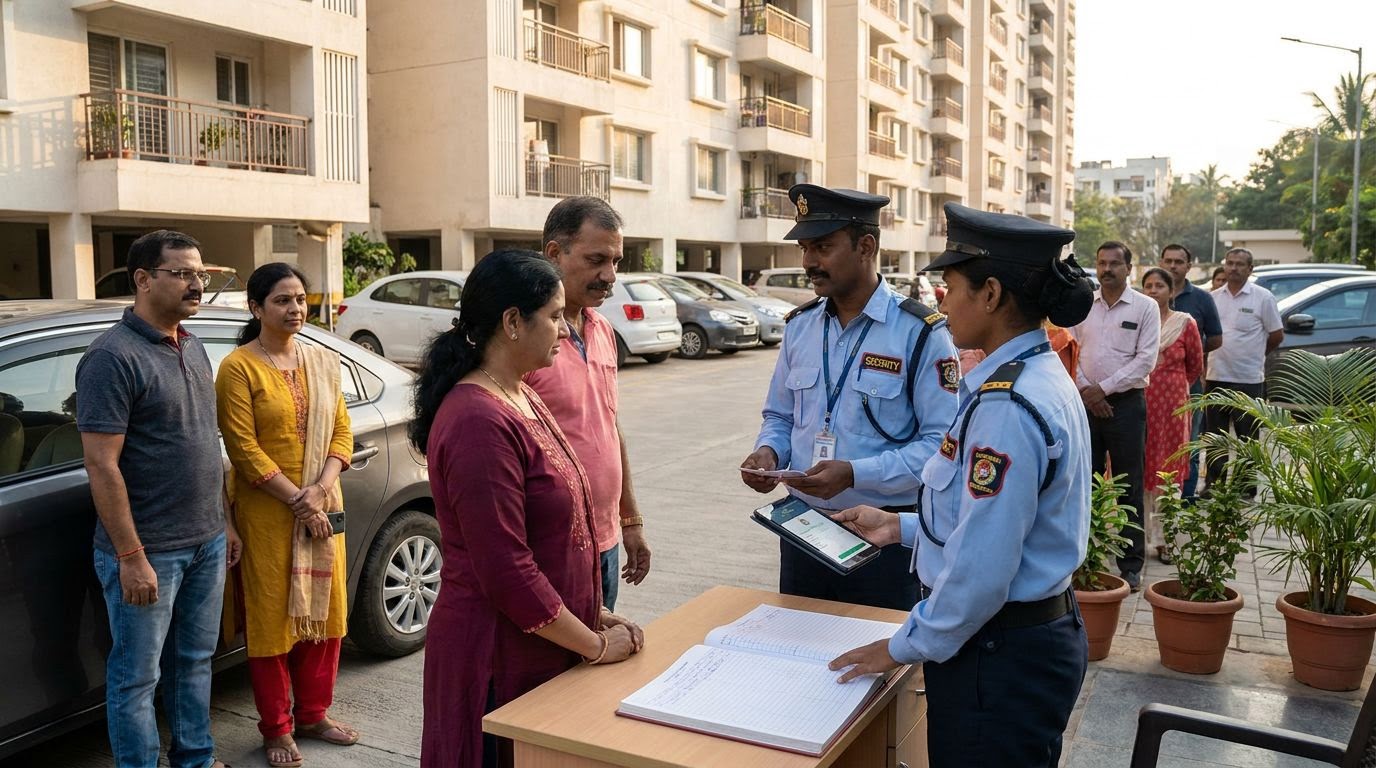
A comprehensive guide for Indian Resident Welfare Associations (RWAs) on designing a robust visitor management system at the main gate, balancing digital apps, physical registers, and trained security personnel.
In modern Indian urban spaces, from the high-rises of Mumbai to the sprawling townships of Pune, the residential gate is no longer just a simple entry point; it has evolved into a complex logistics hub. On any given day, a typical housing society of five hundred apartments receives hundreds of external entries, including delivery executives, domestic helpers, maintenance staff, ride-sharing cabs, and personal guests. Without a structured visitor management system, this constant influx can easily compromise the safety of the residents. Resident Welfare Associations (RWAs) are tasked with the critical responsibility of securing the society gate while ensuring that legitimate visitors experience minimal delay. Achieving this balance requires a thoughtful combination of digital visitor apps, physical registers, trained security personnel, and robust physical access controls.
The Core Components of a Gate Security Framework
An effective visitor management system is never reliant on a single tool. Instead, it is a multi-layered framework where technology and human vigilance work in tandem. RWAs must understand that relying solely on a mobile application or entirely on manual entry books leaves security gaps. A secure society gate requires three main pillars.
1. The Digital Visitor App
Digital visitor management software has transformed how residential complexes manage entries. By allowing residents to pre-approve guests, receive real-time notifications, and approve or deny entry requests directly from their smartphones, these apps reduce the time a visitor spends at the gate. They also create a searchable digital trail of everyone who enters and exits the premises, which is invaluable in the event of a security incident.
2. The Physical Register as a Redundancy Measure
While digital systems are highly efficient, they are not infallible. Internet outages, power failures, or software glitches can temporarily disable digital gate systems. Therefore, maintaining a physical paper register remains an essential backup. Security guards must be trained to seamlessly transition to manual logging during technical downtime, ensuring that the tracking of visitors is never interrupted.
3. Trained Security Personnel
Technology is only an enabler; the ultimate enforcement lies with the security guards at the gate. Even the most sophisticated visitor app is useless if guards allow vehicles to pass without verification. Guards must be trained to verify the matching details on the app, check physical identification cards when necessary, and handle non-compliant visitors politely but firmly.
Establishing Standard Operating Procedures for Gate Entries
An app is only as good as the rules governing its use. RWAs must draft clear, written Standard Operating Procedures (SOPs) for the security team. Under the Private Security Agencies (Regulation) Act, 2005, RWAs must ensure that the security agency they hire is fully licensed. This ensures that the guards deployed at the gate are properly vetted, trained, and capable of enforcing these SOPs. These SOPs should categorize visitors and define the exact verification steps required for each group.
Daily Service Providers and Domestic Staff
Maids, cooks, drivers, and car cleaners enter the society daily. Rather than verifying them individually each time, RWAs should issue RFID cards, biometric access, or unique digital IDs. This allows them to pass through designated pedestrian gates quickly while logging their attendance automatically. Security committees must audit these active profiles monthly to deactivate cards of staff who no longer work in the society.
Delivery Executives and Cabs
With the rise of e-commerce, food delivery, and quick-commerce platforms, delivery personnel make up the largest volume of daily visitors. Guards should use the visitor management system to match the delivery executive's destination with an active order confirmation on the resident's app. For cabs, entry should only be permitted if the resident has pre-booked the ride or confirms the entry via an in-app notification or an intercom call. Vehicles should be tracked to ensure they exit within a reasonable timeframe. In case of any aggressive confrontation or security breach at the gate, guards must immediately contact the society's management and, if necessary, dial the national emergency number 112 for police assistance.
Unannounced Guests and Vendors
For any visitor who has not been pre-approved, the guard must initiate a verification process. The guard enters the visitor's details, takes a photograph if permitted by society guidelines, and sends a notification to the resident. Entry must only be granted once the resident explicitly approves the request. If the resident is unreachable, the visitor must wait outside the gate.
Data Privacy and Compliance under the DPDP Act, 2023
As RWAs adopt digital visitor management systems, they collect a significant amount of personal data, including names, phone numbers, vehicle registration details, and photographs. In India, the enactment of the Digital Personal Data Protection Act, 2023 (DPDP Act) has placed strict responsibilities on entities collecting personal data. Under this law, housing societies and their technology partners are considered data fiduciaries.
RWAs must ensure that their chosen visitor app vendor is fully compliant with the DPDP Act. This means visitor data must be stored securely, encrypted both in transit and at rest, and accessed only for genuine security investigations. Furthermore, societies must establish clear data retention policies. Visitor logs should not be stored indefinitely; they should be automatically purged after a reasonable period, such as 90 to 180 days, unless required for an ongoing legal or security matter. Residents and visitors must also be informed about what data is being collected and for what purpose, typically through a prominent privacy notice displayed at the gate.
Integrating Physical Barriers with Digital Systems
A digital approval on a smartphone screen does not physically stop an unauthorized vehicle or individual from entering. To make a visitor management system truly effective, RWAs must integrate their software with physical entrance-control hardware. This integration ensures that physical barriers only open once digital verification is complete.
For vehicular entry, installing automated boom barriers synchronized with the visitor app or RFID readers prevents tailgating and unauthorized parking. When a resident's car approaches, RFID sensors read the tag and raise the barrier automatically. For visitors, the guard manually triggers the barrier only after completing the digital registration and receiving resident approval. Similarly, implementing secure smart access control systems at pedestrian turnstiles ensures that domestic staff and daily labor can only enter through designated paths after verifying their credentials. This hardware-software synergy reduces human error and prevents guards from bypassing standard security protocols due to fatigue or rush-hour pressure.
Step-by-Step Checklist for RWAs to Implement a VMS
Transitioning to a modern visitor management system requires careful planning and community consensus. RWAs can follow this structured checklist to ensure a smooth rollout:
- Conduct a Security Audit: Assess the physical layout of the main gate, identify blind spots, and determine the daily volume of vehicles and pedestrians.
- Select a Compliant Vendor: Choose a visitor management app that offers robust data encryption, DPDP Act compliance, reliable offline functionality, and an intuitive user interface for guards.
- Upgrade Gate Infrastructure: Ensure the gate has stable internet connectivity, power backup for security devices, adequate lighting, and physical barriers like boom barriers.
- Train the Security Force: Partner with a professional agency providing trained security services to ensure guards understand how to operate the app, handle technical glitches, and manage visitor disputes professionally.
- Educate the Residents: Conduct awareness campaigns, share user manuals, and run a one-week trial period to help residents get accustomed to pre-approving guests and responding to gate notifications promptly.
- Review and Audit: Establish a monthly review process to analyze gate entry data, identify security bottlenecks, and update the database of domestic staff and active residents.
Key Takeaways
- An effective visitor management system combines digital apps, physical backup registers, and trained security personnel.
- Clear Standard Operating Procedures (SOPs) must be defined for different categories of visitors, including deliveries, cabs, and domestic staff.
- Under the DPDP Act, 2023, RWAs must protect visitor data, obtain consent, and implement auto-purge policies for gate logs.
- Integrating digital visitor management with physical hardware like boom barriers and pedestrian access control prevents unauthorized entry.
- Regular training of security guards and continuous resident education are critical for the long-term success of any gate security system.
How STSS Can Help
At S. Tiger Security Service (STSS), we provide comprehensive security solutions tailored to the unique needs of residential societies in Pune and Mumbai. From supplying PSARA-compliant, highly trained security guards to installing advanced physical access barriers, we help RWAs build foolproof gate security frameworks. Contact us today to request a security quotation and secure your housing society.
Frequently Asked Questions
Can a housing society mandate taking photos of all visitors at the gate?
Under the Digital Personal Data Protection Act, 2023, RWAs must obtain explicit consent before collecting personal data, including photographs. While societies can request photos for security, visitors should have the option to opt-out, provided their identity is verified through other valid means.
What happens to visitor data if the app company faces a data breach?
Under Indian law, the RWA acts as the primary data fiduciary, and the app provider is the data processor. The RWA must ensure that its contract with the vendor includes strict data security clauses, liability terms, and immediate breach notification protocols.
How should security guards handle delivery executives who refuse to register?
Guards should politely inform the visitor of the society's security rules. If the executive refuses to comply, entry should be denied, and the resident who ordered the delivery should be contacted to resolve the issue or collect the delivery at the gate.
Is a physical register still necessary if we use a modern visitor app?
Yes. Physical registers serve as a critical backup during internet outages, power failures, or application server downtime, ensuring that gate tracking is never interrupted.
How can RWAs prevent tailgating at the vehicle entry gate?
Integrating the visitor management app with automated physical barriers, such as boom barriers, ensures that only one pre-verified vehicle can pass at a time when the barrier is raised.
STSS provides trained guards, e-surveillance, access control and turnkey security across India.
This article was drafted with the help of an AI writing assistant and published by the STSS knowledge desk for general awareness only. It is not legal or professional advice. In an emergency, dial 112. Report cyber fraud on 1930 or cybercrime.gov.in.