
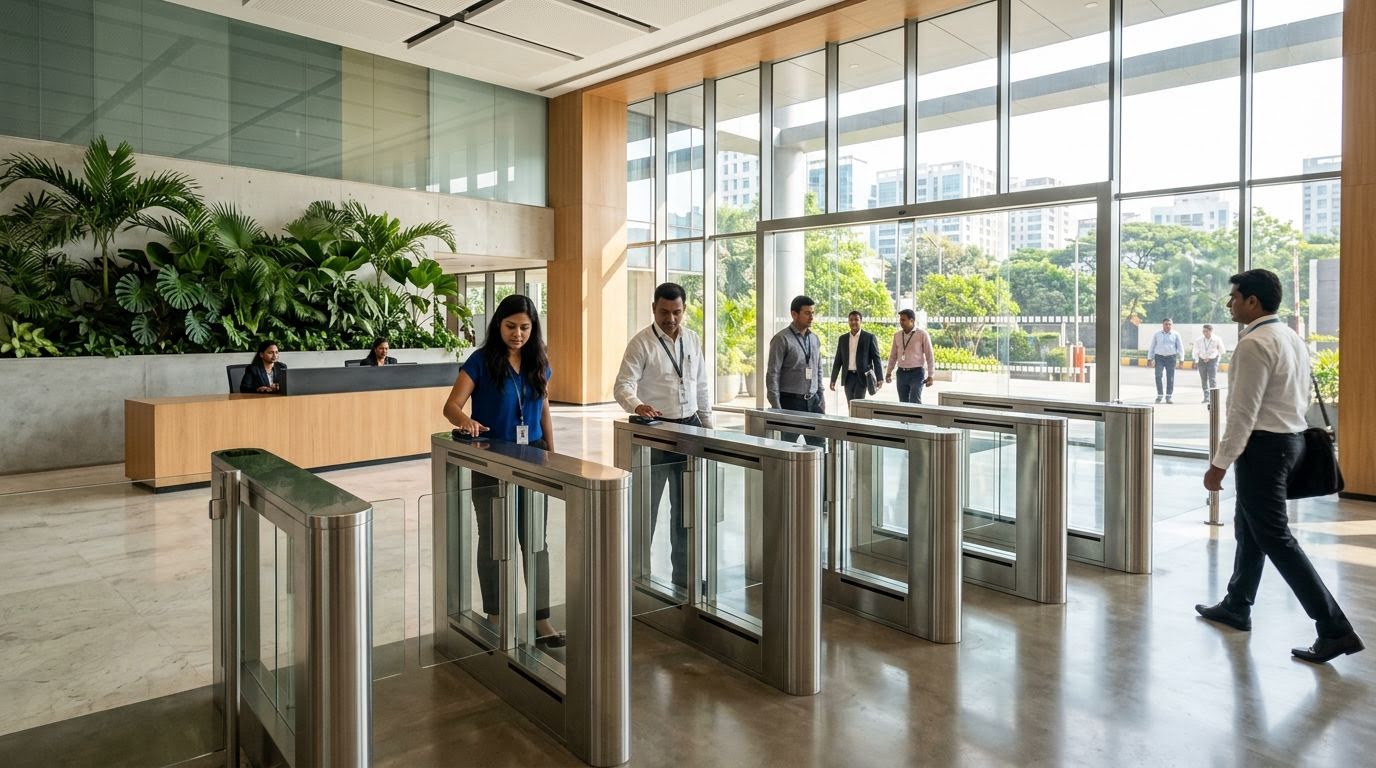
Selecting the right pedestrian entrance control system is critical for modern Indian facilities. Compare the security, speed, and cost of turnstiles, flap barriers, and speed gates.
The Importance of Pedestrian Entrance Control
Modern commercial spaces, IT parks, manufacturing plants, and transit hubs in India face a common challenge: managing the daily movement of thousands of employees, visitors, and vendors. Uncontrolled entry points not only increase the risk of unauthorised access but also strain security personnel. To address this, organisations rely on automated pedestrian entrance control systems to regulate flow, verify credentials, and secure premises.
Among the most common physical barriers used today are tripod turnstiles, flap barriers, and speed gates. While all three systems serve the primary purpose of restricting unauthorised entry, they differ significantly in terms of throughput capacity, security level, aesthetic appeal, and capital cost. Selecting the wrong system can lead to bottlenecks at your reception, high maintenance costs, or security gaps that compromise your facility. This guide provides an in-depth comparison to help facility managers, housing society committees, and security heads make an informed decision.
Understanding Tripod Turnstiles: The Durable Workhorse
Tripod turnstiles are the most traditional and widely recognised entrance control systems. They consist of three rotating metal arms positioned at 120-degree angles. When a user presents a valid credential, the locking mechanism releases, allowing one person to push through the arm, which then rotates and locks again.
How They Work and Where They Excel
Tripod turnstiles operate on simple mechanical or electro-mechanical principles. Because of their robust construction, usually using high-grade stainless steel, they are exceptionally durable and can withstand heavy physical impact and harsh environmental conditions. This makes them ideal for industrial facilities, manufacturing units, construction sites, and public venues like amusement parks or stadiums where aesthetic appeal is secondary to sheer durability.
Security Level and Limitations
While turnstiles are highly effective at enforcing one-by-one passage, they offer a moderate level of security. A determined intruder can climb over or crawl under the rotating arms. Additionally, they do not offer advanced detection for tailgating (where an unauthorised person follows closely behind an authorised user). From an aesthetic standpoint, tripod turnstiles have an industrial appearance that may not align with the modern, high-end design of premium corporate offices or luxury residential lobbies.
Flap Barriers: Balancing Speed and Aesthetics
Flap barriers feature soft or rigid wings (usually made of acrylic, glass, or polyurethane) that retract into the housing cabinet upon receiving a valid signal. Unlike turnstiles, which require physical contact to push open, flap barriers offer a touchless experience as the wings slide open automatically.
Mechanism and User Experience
The touchless operation of flap barriers makes them highly hygienic and user-friendly, which has contributed to their widespread adoption in Indian corporate offices and metro transit systems. When a user taps an RFID card or scans a QR code, the flaps quickly retract inside the cabinet, creating a clear pathway. This rapid opening and closing mechanism ensures a smooth, non-intrusive flow of people.
Throughput and Suitability
Flap barriers are designed for high-throughput environments. They can comfortably handle 30 to 45 passages per minute, making them the preferred choice for mass transit stations, large universities, and busy office buildings during peak morning and evening rush hours. While they look much sleeker than tripod turnstiles, they still present a physical barrier that can, in extreme cases, be jumped over, though doing so will immediately trigger built-in audible alarms.
Speed Gates: Premium Design Meets High Security
Speed gates represent the pinnacle of pedestrian entrance control. They feature sleek, elongated cabinets and glass barrier wings that swing open or slide horizontally. Speed gates combine advanced sensor technology with premium materials to deliver high security without compromising on architectural aesthetics.
Advanced Sensor Technology and Tailgating Detection
The defining feature of a speed gate is its sophisticated array of infrared (IR) sensors. These sensors track the exact position of a person passing through the lane. If a second person attempts to follow the authorised user without scanning a credential, the system detects this tailgating attempt immediately, sounds an alarm, and keeps the glass barriers firmly closed. This makes speed gates highly effective at preventing unauthorised entry in high-security environments.
Architectural Appeal and Customisation
With their minimalist design, glass panels, and customisable LED lighting, speed gates blend seamlessly into modern, high-end corporate lobbies, bank headquarters, and premium research facilities. They can be integrated with facial recognition cameras, biometric fingerprint readers, and visitor management systems. Additionally, speed gates can be configured with taller glass barriers (up to 1.8 metres) to prevent intruders from climbing over, offering a much higher physical security barrier than turnstiles or flap barriers.
Direct Comparison: Throughput, Security, Aesthetics, and Cost
To help you choose the right system for your facility, the table below compares the key parameters of tripod turnstiles, flap barriers, and speed gates.
| Feature | Tripod Turnstiles | Flap Barriers | Speed Gates |
|---|---|---|---|
| Throughput | Low to Moderate (20-30 people/min) | High (30-45 people/min) | Very High (35-50 people/min) |
| Security Level | Moderate (Can be climbed over/under) | Moderate to High (Alarms for tailgating) | High to Very High (Advanced sensor tracking) |
| Aesthetic Appeal | Basic / Industrial | Modern / Professional | Premium / Minimalist |
| Tailgating Prevention | Mechanical separation only | Sensor-based alarm | Advanced multi-sensor detection & block |
| Relative Cost | Economical | Moderate | Premium |
| Best Suited For | Factories, construction sites, gyms | Metro stations, mid-tier offices, colleges | Corporate HQs, banks, high-security zones |
Special Considerations for Indian Facilities
When selecting and deploying entrance control systems in India, facility managers must consider several unique local factors to ensure long-term operational success.
Integration with Biometrics and the DPDP Act
In India, biometric access control—specifically facial recognition and fingerprint scanning—is highly popular. When integrating these scanners with your entrance lanes, you must ensure compliance with the Digital Personal Data Protection Act, 2023 (DPDP Act). This involves obtaining explicit consent from employees and visitors before processing their biometric data and ensuring that the data storage mechanisms are secure and audit-ready.
Dust and Environmental Resilience
Indian cities often experience high levels of ambient dust and varying humidity. Tripod turnstiles and flap barriers installed near main entrances or semi-outdoor areas must have an appropriate Ingress Protection (IP) rating, typically IP54 or higher. Dust accumulation can interfere with the optical sensors of flap barriers and speed gates, leading to false alarms or mechanical failures. Regular cleaning schedules and choosing systems with sealed optical components are essential.
Wheelchair Access and Emergency Evacuation
Standard tripod turnstiles and flap barriers do not provide sufficient clearance for wheelchair users, delivery trolleys, or large luggage. To address this, facilities must install at least one wide-lane barrier, often referred to as a disability gate or swing gate, alongside the standard lanes. Furthermore, all entrance control systems must be integrated with the building's central fire alarm control panel. In the event of an emergency, the barriers must automatically retract, swing open, or drop their arms to ensure unhindered evacuation.
Selection Checklist: Choosing the Ideal System
Use this checklist to evaluate your facility's requirements before making an investment:
- Define the primary objective: Are you looking for basic deterrents (turnstiles), high-speed transit flow (flap barriers), or high-security tailgating prevention (speed gates)?
- Measure peak traffic: Calculate the number of people entering during the busiest 15-minute window of the day to determine the number of lanes required.
- Assess space constraints: Ensure your lobby has sufficient width to accommodate the cabinets, the barrier pathway, and at least one wide lane for wheelchair accessibility.
- Verify integration capabilities: Confirm that the selected hardware is compatible with your existing access control software, HR attendance systems, and visitor management platforms.
- Evaluate total cost of ownership: Consider not just the initial purchase price, but also installation costs, annual maintenance contracts (AMC), and the availability of spare parts locally in India.
Key Takeaways
- Tripod Turnstiles offer a highly durable and cost-effective solution for industrial environments, factories, and sites with basic security needs.
- Flap Barriers provide a fast, touchless, and modern solution ideal for high-traffic environments like metro stations and busy corporate offices.
- Speed Gates deliver the highest level of security, advanced tailgating detection, and premium aesthetics, making them perfect for executive offices and financial institutions.
- Safety and compliance are paramount; always ensure your entrance control lanes are integrated with the building’s fire alarm system for automatic fail-safe operation.
- Accessibility must not be overlooked; always include at least one wide-lane swing gate to accommodate wheelchair users and heavy luggage.
How STSS Can Help
At S. Tiger Security Service (STSS), we design, supply, and integrate high-performance pedestrian entrance control systems tailored to your facility's unique operational needs. From heavy-duty industrial turnstiles to premium, high-security speed gates, our experts ensure seamless installation, biometric integration, and reliable post-sales support. To secure your facility with the right entrance control solution, visit our page and request a security quotation today.
Frequently Asked Questions
What happens to flap barriers and speed gates during a power failure or fire emergency?
Most modern flap barriers and speed gates feature a fail-safe mechanism. When power is lost or a signal is received from the building's fire alarm panel, the barriers automatically retract or swing open to create a clear, unobstructed path for emergency evacuation.
Can tripod turnstiles accommodate wheelchair users or large baggage?
No, standard tripod turnstiles are too narrow for wheelchair users or large luggage. To ensure accessibility and compliance with inclusive design standards, facilities must install at least one wider swing gate or disability gate alongside standard turnstile lanes.
How do speed gates prevent tailgating?
Speed gates are equipped with advanced infrared (IR) sensor arrays along the length of the cabinet. These sensors track the movement of an authorised individual and can immediately detect if a second person attempts to follow closely behind, triggering an audible alarm and locking the barrier.
What is the average lifespan of a high-quality flap barrier?
A high-quality flap barrier with a Mean Cycles Between Failures (MCBF) of 5 million to 10 million cycles can easily last 8 to 10 years, provided it undergoes regular preventive maintenance and servicing.
Are speed gates and flap barriers suitable for outdoor installation?
Standard speed gates and flap barriers are designed for indoor use. For outdoor entry points, such as factory gates or construction sites, heavy-duty tripod turnstiles or full-height turnstiles with appropriate IP (Ingress Protection) ratings and protective canopies are highly recommended.
STSS provides trained guards, e-surveillance, access control and turnkey security across India.
This article was drafted with the help of an AI writing assistant and published by the STSS knowledge desk for general awareness only. It is not legal or professional advice. In an emergency, dial 112. Report cyber fraud on 1930 or cybercrime.gov.in.