
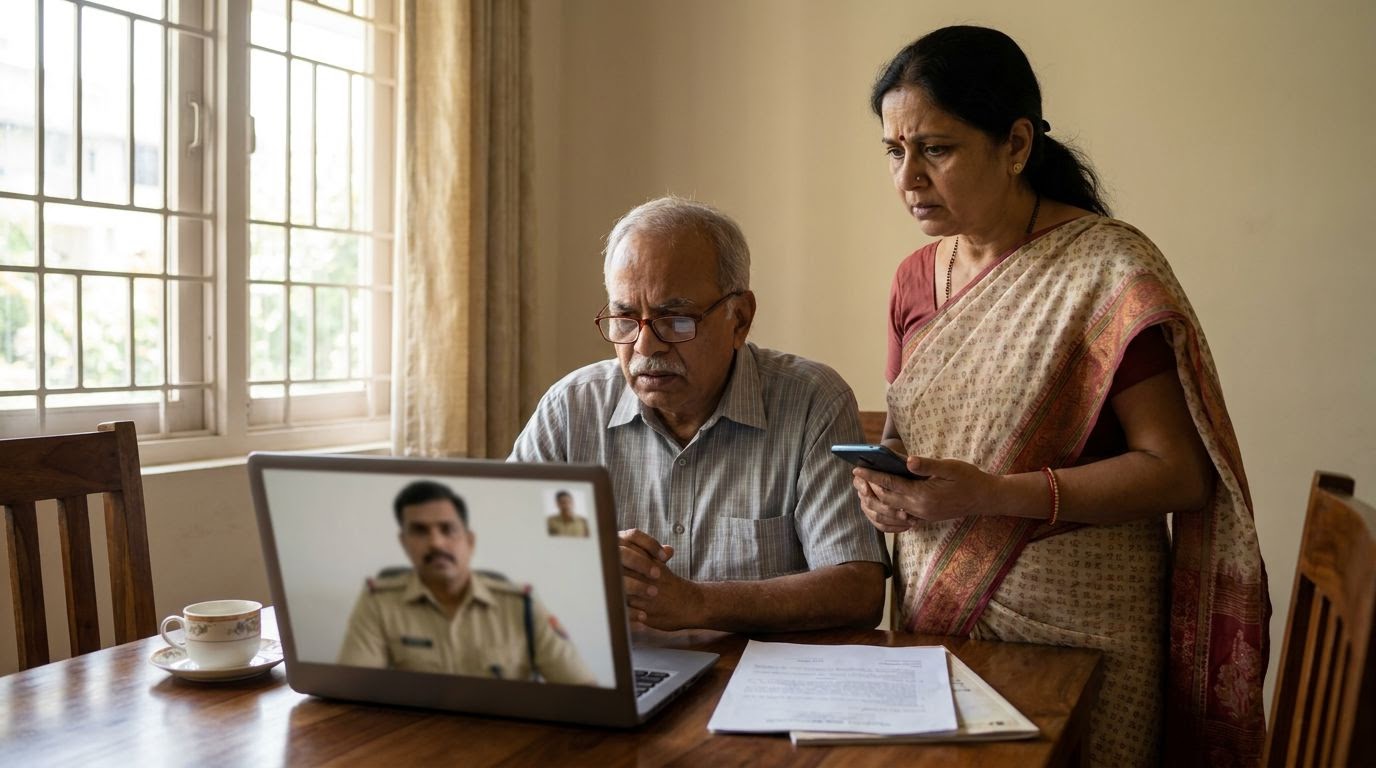
Digital arrest scams are rising rapidly across India, with fraudsters impersonating police and CBI officers on video calls to extort money. Learn how to identify these fake calls and protect your family.
In recent months, a highly sophisticated cyber fraud method known as the "digital arrest scam" has emerged as a major security threat across India. Targeting retired professionals, homemakers, corporate employees, and senior citizens alike, these syndicates exploit fear and respect for authority. Fraudsters pose as officers from the Central Bureau of Investigation (CBI), the Narcotics Control Bureau (NCB), State Police departments, or the Enforcement Directorate (ED). By keeping victims under constant surveillance via video calls, they extort lakhs of rupees under the pretext of resolving fabricated criminal cases. Understanding how these criminals operate is the first and most crucial step in protecting yourself and your family from financial and psychological harm.
What is a Digital Arrest Scam?
A digital arrest scam is a form of cyber extortion where criminals convince a victim that they are under "virtual custody" or "digital arrest" for a serious crime. The fraudsters claim that the victim's identity has been linked to illegal activities, such as money laundering, drug trafficking, or sending contraband packages. Under the threat of immediate physical arrest and public humiliation, the victim is forced to remain on a continuous video call, effectively isolating them from family, friends, and legal counsel, until they transfer large sums of money as "temporary bail" or "verification fees."
It is critical to understand that the term "digital arrest" has no legal validity in India. Under the Bharatiya Nyaya Sanhita, 2023, and the Code of Criminal Procedure, there is absolutely no provision that allows any law enforcement agency to arrest, detain, or hold a citizen in custody over a video call. Real law enforcement actions require physical presence, written warrants, and official documentation.
The Anatomy of a Video Call Fraud
These scams are meticulously planned and executed with high psychological precision. Fraudsters use a multi-stage approach to break down the victim's skepticism and induce panic.
The Initial Scare Tactics
The scam usually begins with an automated robocall or an interactive voice response (IVR) message claiming to be from a courier company like FedEx, or a telecom authority. The caller informs the victim that a parcel sent in their name has been intercepted by customs. They claim the package contains illegal items, such as synthetic drugs, fake passports, or banned chemicals. Alternatively, they may claim that a mobile SIM card registered under the victim's Aadhaar card is being used to broadcast illegal advertisements or conduct financial frauds.
The CBI Impersonation and Fake Police Call
Once the victim denies any involvement, the caller pretends to "transfer" the call to a senior police official or a CBI investigator to clear their name. The victim is then instructed to download a video conferencing application such as Skype, Zoom, or Microsoft Teams. When the video call connects, the victim sees a highly convincing setup: individuals dressed in realistic police uniforms sitting in front of backdrops that mimic actual police stations, complete with official-looking seals, banners, and files. To further legitimise the scam, the fraudsters may display forged arrest warrants, official letters bearing national emblems, and fake ID cards of real IPS officers.
The Digital Captivity
Once the video call fraud is established, the criminals declare that the victim is under "digital arrest." They command the victim to keep their camera on at all times, including while sleeping or using the washroom. They warn the victim that any attempt to disconnect the call, contact family members, or consult a lawyer will be treated as non-cooperation, leading to immediate physical arrest by a local police team. This prolonged state of isolation and surveillance is designed to exhaust the victim mentally, impairing their decision-making ability.
Why Real Law Enforcement Never Uses Video Calls for Arrests
No Indian law enforcement agency, including the CBI, State Police, Customs Department, or the Income Tax Department, operates in this manner. To protect yourself, keep these fundamental legal realities in mind:
- No Arrests via Skype or Zoom: Real police officers will never conduct an interrogation or place you under arrest over a video call.
- No Demands for Money: Government agencies do not ask citizens to transfer money to "secret government accounts" or "verification accounts" to prove their innocence. All official financial transactions, penalties, or bail amounts are processed through courts or designated government portals with formal receipts.
- Official Written Summons: If you are required for an investigation, the police will issue a physical, written summons under the appropriate provisions of the law. They do not send unofficial PDFs of warrants over WhatsApp.
- Verification of Credentials: Real officers will always ask you to report to the nearest police station in person. They will never demand that you keep your camera on to monitor your movements.
Red Flags of a Fake Police Call
Recognising the warning signs early can save you from falling victim to these elaborate schemes. Be alert to the following red flags:
| Scammer's Tactic | The Real Procedure |
|---|---|
| Demands immediate money transfer via RTGS/IMPS to "verify" your bank account. | Police cannot freeze, unfreeze, or verify bank accounts through direct peer-to-peer transfers. |
| Insists on absolute secrecy and threatens physical arrest if you tell anyone. | Every citizen has the legal right to contact a lawyer, family members, and local police. |
| Uses WhatsApp or Skype to display official-looking badges and documents. | Official government communications are never conducted through personal social media accounts. |
| Creates extreme urgency, claiming you must act within minutes to avoid jail. | Legal processes follow structured, time-bound steps, not immediate threats over a phone call. |
Step-by-Step Action Plan: What to Do If Targeted
If you receive a suspicious call claiming you are involved in a crime or are under digital arrest, follow these steps immediately:
- Disconnect the Call Immediately: Do not engage in arguments, do not try to defend your innocence, and do not download any apps suggested by the caller.
- Do Not Share Personal Information: Never share your Aadhaar number, bank account details, OTPs, or home address with unknown callers.
- Verify Independently: If you are concerned, look up the official contact number of your local police station or the agency they claimed to represent. Call them directly or visit them in person to verify the claims.
- Talk to Your Family: Immediately inform a family member, neighbour, or trusted friend about the call. Fraudsters rely on isolating you; breaking the silence destroys their power.
- Secure Your Digital Presence: If you have shared any bank details, contact your bank immediately to freeze your accounts and block your cards. Consider upgrading your home security and digital monitoring through e-Surveillance Services to prevent physical follow-ups by local imposters.
How to Report Cyber Fraud in India
If you or someone you know has been targeted or defrauded, acting quickly is vital. The Government of India has established dedicated channels to handle cybercrimes under the Information Technology Act, 2000.
Immediately dial the National Cyber Crime Helpline at 1930. This helpline is operational 24/7. Reporting the transaction within the "golden hour" (the first two hours of the transfer) significantly increases the chances of the bank freezing the defrauded money before the scammers can withdraw it. Additionally, file a formal complaint online at the official portal: cybercrime.gov.in. Keep screenshots of the call logs, video call screens, WhatsApp and Skype chats, and bank transaction details as evidence.
Key Takeaways
- There is no legal concept of "digital arrest" in India; no law enforcement agency can detain you over a video call.
- Fraudsters use realistic uniforms, fake office backdrops, and forged documents to look authentic.
- Never transfer money to any account for "verification" or "bail" during a phone or video call.
- If targeted, hang up immediately, talk to your family, and report the incident to the national helpline at 1930.
How STSS Can Help
While digital safety requires constant vigilance, physical security and integrated safety protocols are equally important for protecting your home and business. S. Tiger Security Service (STSS) provides comprehensive, PSARA-licensed Security Services designed to safeguard your premises against physical intrusion and unauthorised access. To learn more about our custom security solutions, please request a quote today.
Frequently Asked Questions
Can the CBI or Police arrest me over a WhatsApp or Skype call?
No. No Indian law enforcement agency has the legal authority to arrest, interrogate, or detain any citizen over a video call. Physical presence and formal legal procedures are mandatory for any arrest.
What should I do if a scammer shows me a fake arrest warrant with my name on it?
Disconnect the call immediately. Scammers easily forge official documents, logos, and stamps using basic digital editing tools. Real warrants are served physically by police officers, not sent via WhatsApp or email.
Is there a fee to verify my bank account with the police?
No. Police and investigative agencies never ask citizens to transfer money to "secret" or "verification" bank accounts. Any demand for money over a phone or video call is a scam.
How does the 1930 helpline help if I have already lost money?
The 1930 helpline connects you to the National Cyber Crime Reporting Portal. If you report the fraud immediately, the portal coordinates with banks to block the transaction and freeze the stolen funds before the scammers can withdraw them.
How can I identify a fake police officer on a video call?
Real police officers will never demand that you stay on a video call, isolate yourself, or show them your bank accounts. If they refuse to let you contact a lawyer or family member, or if they demand money, they are fake.
STSS provides trained guards, e-surveillance, access control and turnkey security across India.
This article was drafted with the help of an AI writing assistant and published by the STSS knowledge desk for general awareness only. It is not legal or professional advice. In an emergency, dial 112. Report cyber fraud on 1930 or cybercrime.gov.in.