
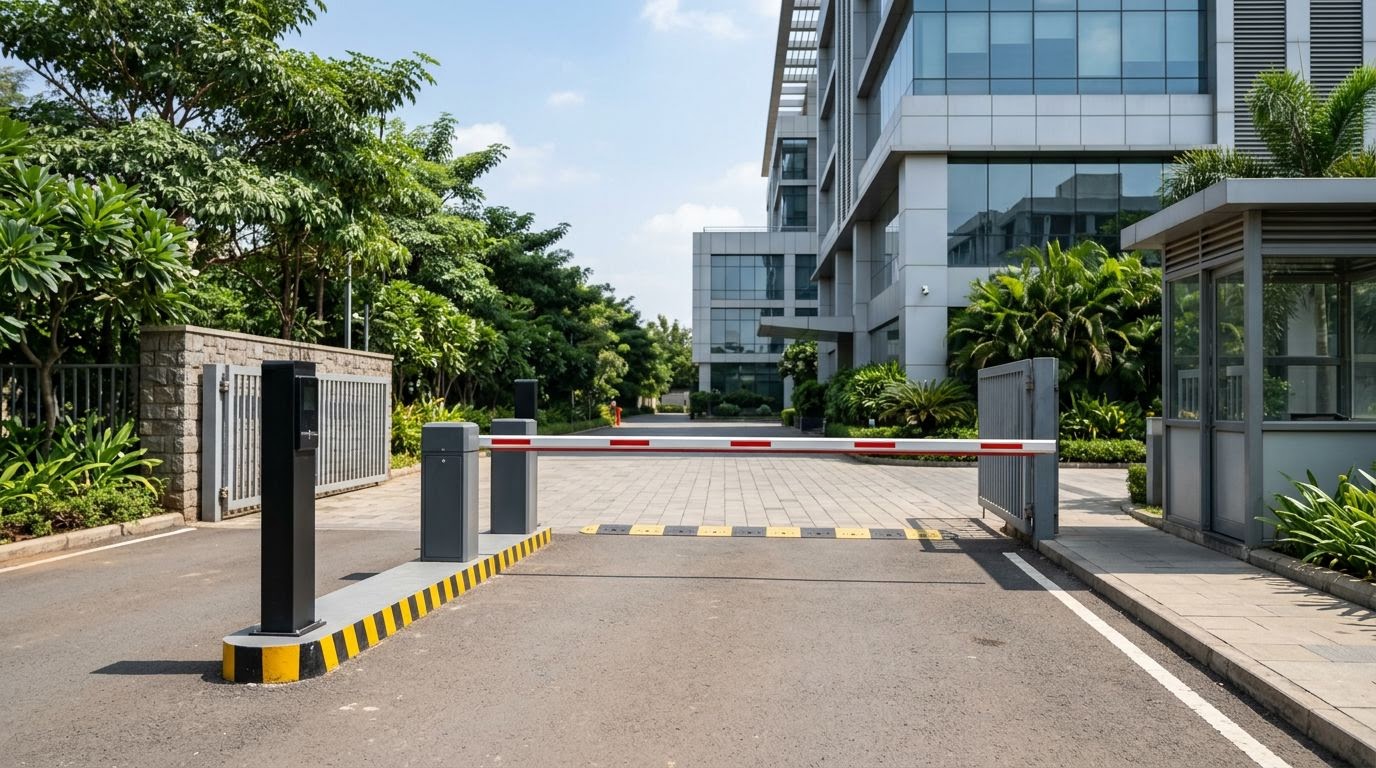
Regulating vehicle access is crucial for modern Indian properties. Learn how to choose the right boom barrier by comparing manual and automatic models, speeds, and access integrations.
Regulating vehicle movement is a critical component of perimeter security for any modern Indian establishment. Whether it is a sprawling residential housing society in Pune, a high-security corporate park in Mumbai, or a busy manufacturing facility, managing who enters and exits is vital for safety, accountability, and traffic management. A high-quality boom barrier serves as the primary physical gateway, acting as both a visual deterrent and an effective regulatory mechanism. Selecting the right parking barrier or automatic gate barrier requires a clear understanding of your site's specific traffic patterns, physical dimensions, and integration needs with modern vehicle access control systems.
Manual vs. Automatic Boom Barriers
The first decision when securing a gate is choosing between manual and automatic operations. While both serve the basic purpose of blocking vehicle entry, their operational efficiency, long-term costs, and security capabilities differ significantly.
Manual Boom Barriers
Manual barriers rely entirely on physical human effort. A security guard must physically unlock and lift the counterbalanced arm to allow vehicles to pass. While these systems have low upfront installation costs and require no electricity, they present several operational challenges in modern environments. They are slow, lead to vehicle queuing during peak hours, and increase guard fatigue. Manual barriers are best suited for low-traffic sites, temporary construction zones, or remote locations where electrical power is unavailable or highly unstable.
Automatic Gate Barriers
Automatic barriers are powered by electromechanical or hydraulic drive units. They can be operated via remote controls, push buttons, or integrated access control systems. These barriers offer rapid operation, consistent performance, and significantly reduce the physical burden on security personnel. For busy residential complexes, IT parks, and commercial hubs, an automatic system is essential to maintain smooth traffic flow and ensure that security guards can focus on verifying visitors rather than manually lifting heavy gates.
Understanding Arm Lengths and Gate Geometry
The physical layout of your entrance determines the physical specifications of the barrier arm, also known as the boom profile. Standard boom arms range from 2 meters to over 6 meters in length. Choosing the correct length is critical to prevent vehicles from squeezing past the barrier while ensuring the arm does not strike overhead obstructions.
Straight Boom Arms
The straight boom arm is the most common type used across India. It is highly effective for open-air entrances, such as main roads entering housing societies or factories. However, the arm must match the road width. If the road is exceptionally wide, installing two synchronized barriers on opposite sides of the gate is often more practical than installing a single, excessively long arm, which can bend or experience high wind resistance.
Articulated and Folding Boom Arms
In indoor environments, such as basement parking lots or multi-level parking structures, vertical clearance is often limited. A standard straight arm would hit the ceiling when raised. In such cases, an articulated or folding boom arm is used. These arms feature a mechanical joint that folds the barrier at a 90-degree angle as it rises, allowing full clearance for vehicles while staying within low ceiling heights.
Fence or Skirt Barriers
Standard single-bar boom barriers prevent cars from entering but often allow two-wheelers, pedestrians, or stray animals to slip underneath. To address this, some barriers feature a hanging fence or "skirt" made of lightweight aluminium strips. This fence folds flat when the barrier is raised and expands vertically when lowered, creating a complete physical screen that secures the entire height of the opening.
Operating Speeds and Duty Cycles
When selecting an automatic gate barrier, operational speed and duty cycle are two technical specifications that cannot be overlooked. Matching these parameters to your site's peak traffic flow prevents premature equipment failure and gate congestion.
Opening and Closing Speeds
The time it takes for a barrier to raise completely varies based on its design and application:
- High-Speed Barriers (1 to 1.5 seconds): Essential for toll plazas, high-frequency parking garages, and busy logistics hubs where every second matters to prevent traffic pile-ups.
- Standard-Speed Barriers (3 to 4 seconds): Ideal for corporate offices and commercial complexes with moderate to high traffic.
- Low-Speed Barriers (5 to 6 seconds): Suitable for residential housing societies and private properties where traffic is steady but rarely concentrated in rapid bursts.
Duty Cycle Explained
The duty cycle represents the percentage of time a barrier can operate continuously without the motor overheating. A barrier with a 100% duty cycle can run non-stop, which is mandatory for commercial sites and toll gates. Residential gates, which experience peak traffic only during morning and evening rush hours, can often operate reliably with a 50% to 80% duty cycle, offering a more cost-effective solution without compromising durability.
Integration with Vehicle Access Control Systems
A boom barrier is only as smart as the system that controls it. Modern security demands seamless integration with advanced Secure & Smart Access Control systems to eliminate manual intervention and create digital audit trails of all vehicle movements.
RFID and FASTag Integration
Radio Frequency Identification (RFID) is the most popular method for automated entry in Indian housing societies and corporate offices. Long-range RFID readers installed at the gate detect a passive tag affixed to the vehicle's windshield. If the vehicle is registered, the system automatically triggers the barrier to open. Many modern facilities are now leveraging existing FASTag readers to streamline access, reducing the need to issue separate proprietary tags.
Automatic Number Plate Recognition (ANPR)
ANPR technology uses high-definition cameras and optical character recognition software to read license plates as vehicles approach the gate. The system compares the plate number against an authorised database. If a match is found, the barrier opens, and the entry time, vehicle image, and plate details are logged. This is highly effective for visitor management and commercial parking lots. For high-security zones, combining ANPR with Under Vehicle Surveillance Systems ensures comprehensive screening of every vehicle entering the premises.
Safety Loops and Photoelectric Sensors
To prevent the barrier arm from accidentally closing on a vehicle or pedestrian, safety integrations are mandatory. Loop detectors are electromagnetic coils buried in the road surface directly under the barrier path. They detect the metallic mass of a vehicle and prevent the arm from lowering until the vehicle has completely cleared the zone. Photoelectric safety beams project an infrared light across the driveway; if a vehicle or person breaks the beam, the barrier immediately reverses or stays open.
Selecting the Right Barrier for Specific Indian Facilities
Different facilities have unique operational priorities, requiring tailored barrier solutions.
| Facility Type | Typical Traffic Volume | Recommended Speed | Key Integration Features |
|---|---|---|---|
| Housing Societies (RWAs) | Moderate (Peak hours) | 4 - 6 seconds | RFID, Safety Loop, Manual Override |
| Corporate IT Parks | High | 2 - 3 seconds | ANPR, RFID, Visitor Management Software |
| Industrial & Logistics | Heavy Vehicles / Low Frequency | 4 - 6 seconds | Long Arm, Crash-Rating, Safety Loops |
| Toll Plazas & Malls | Very High / Continuous | 1 - 1.5 seconds | 100% Duty Cycle, Rapid Open, Loop Detectors |
For high-security industrial areas or critical infrastructure, standard barriers may need to be paired with heavy-duty physical security systems. You can explore specialized options like Boom Barriers designed for robust industrial environments to ensure your perimeter remains secure under all conditions.
Essential Safety and Weatherproofing Features
Operating outdoor security equipment in India requires careful consideration of environmental factors. Heavy monsoon rains, intense summer heat, and high dust levels can degrade sensitive electronic and mechanical components quickly.
- Ingress Protection (IP) Rating: Ensure the barrier housing has at least an IP54 rating, though IP65 is preferred for coastal or heavy-rainfall regions. This protects the internal motor and control board from dust and water entry.
- Anti-Crush Technology: Modern automatic barriers feature smart detection that senses resistance. If the arm touches an obstacle while lowering, it immediately stops and reverses to prevent vehicle damage or personal injury.
- Manual Release Key: In the event of a total power failure or system malfunction, a secure manual release mechanism must be accessible via a physical key, allowing security personnel to raise the arm manually and prevent traffic blockages.
Checklist for Choosing a Boom Barrier
Before purchasing and installing a vehicular barrier system, review this practical checklist to ensure all operational requirements are met:
- Determine the exact road width: Measure the entrance to select the correct arm length (straight, telescopic, or dual synchronized barriers).
- Assess vertical clearance: Check for low-hanging cables, trees, or ceilings that might require an articulated (folding) arm.
- Calculate daily cycle requirements: Estimate the total number of operations per day and peak-hour frequency to choose the right motor duty cycle.
- Define access control needs: Decide whether the gate will be operated via RFID, ANPR, push-button, or remote control.
- Verify safety mechanisms: Ensure the package includes loop detectors, safety photocells, and rubber profiles on the boom arm to cushion impacts.
- Confirm power backup: Verify if the system can run on a dedicated UPS or solar power backup during load shedding.
- Check warranty and local maintenance support: Ensure spare parts like replacement arms, springs, and control boards are readily available locally.
Key Takeaways
- Match the speed to traffic: High-traffic commercial gates and toll booths require rapid-opening barriers (1-3 seconds), while residential gates can operate with standard speeds (4-6 seconds).
- Choose the correct arm style: Use straight arms for open driveways, articulated arms for low-ceiling basements, and skirt/fence barriers to prevent pedestrians and two-wheelers from slipping underneath.
- Prioritise safety: Never install an automatic barrier without safety loops or photoelectric sensors to prevent accidental damage to vehicles and injuries to pedestrians.
- Weatherproofing is vital: Ensure the barrier enclosure has an adequate IP rating (IP54 or higher) to withstand Indian monsoons and summer heat.
- Integrate for efficiency: Connect your barrier with RFID or ANPR systems to automate resident entry, reduce human error, and keep accurate digital logs.
How STSS Can Help
At S. Tiger Security Service (STSS), we design and deploy integrated vehicle access solutions tailored to the unique security needs of Indian enterprises and residential communities. From high-speed automatic barriers to integrated RFID and ANPR systems, our team ensures seamless installation, robust performance, and reliable maintenance support. To secure your facility's entry points with the right technology, visit our page to Request a security quotation today.
Frequently Asked Questions
Can automatic boom barriers work during a power cut?
Yes. Most modern automatic boom barriers have a manual release key that allows security guards to raise the arm manually during power failures. Additionally, they can be connected to an external UPS or back-up generator to maintain automated operations.
What is the difference between electromechanical and hydraulic boom barriers?
Electromechanical barriers use electric motors and gearboxes, making them cost-effective and ideal for residential and commercial gates. Hydraulic barriers use pressurized fluid, offering smoother operation, higher durability for continuous high-speed use (like toll plazas), but at a higher cost.
How do loop detectors protect vehicles from being hit by the barrier arm?
A loop detector consists of an inductive wire loop buried in the road surface under the barrier. It detects the metal body of a vehicle parked or passing underneath, sending a signal to the controller to keep the barrier arm raised until the vehicle has safely crossed.
Can we use FASTag to open our society's automatic boom barrier?
Yes. Modern vehicle access control systems can be integrated with FASTag readers. By registering the existing FASTag IDs of residents' vehicles into your gate security system, the barrier will open automatically without requiring additional RFID tags.
STSS provides trained guards, e-surveillance, access control and turnkey security across India.
This article was drafted with the help of an AI writing assistant and published by the STSS knowledge desk for general awareness only. It is not legal or professional advice. In an emergency, dial 112. Report cyber fraud on 1930 or cybercrime.gov.in.